
“Some endings don’t ask you to stop. They ask you to look farther.”

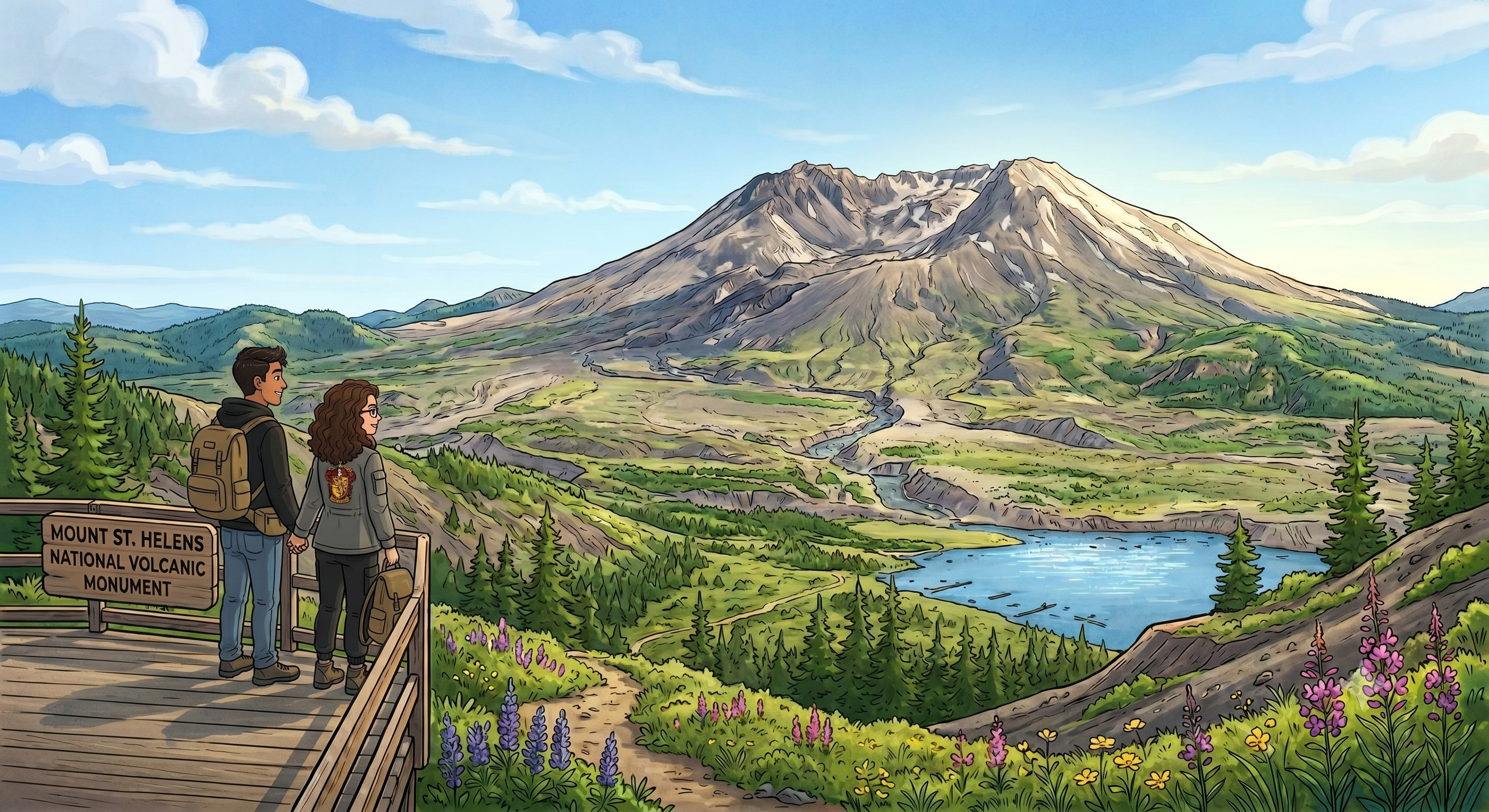
When we took Exit 49 from I-5 North toward WA-504 and Castle Rock, little did we know that nature had prepared something unforgettable for us that morning. The drive itself felt cinematic. It was still early, with only a handful of cars on the road. The Pacific Northwest was doing what it does best — sunlight slipping in and out of heavy clouds, mountains appearing and disappearing behind layers of mist, forests stretching endlessly into the horizon.
As we drove deeper into the Gifford Pinchot National Forest, the landscape slowly began to change. Every turn felt quieter. Larger. Older. And then we saw her. Mount Saint Helens. Snow-covered, massive, and impossibly still against the moody Washington sky. For a moment, both my wife and I simply stopped talking.
We looked at each other and said almost the exact same thing: “We’re so grateful that we live in the Pacific Northwest where we can truly be one with nature.” It was one of those rare moments where gratitude arrives naturally — without effort, without performance, without words needing refinement. But as beautiful and peaceful as the mountain appeared that morning, history tells a very different story.
Because on May 18, 1980, this landscape witnessed unimaginable devastation.
The Weight of the Eruption

At approximately 8:32 a.m. PDT on May 18, 1980, Mount Saint Helens erupted after a powerful earthquake triggered the collapse of the mountain’s north face. What followed became one of the deadliest and most destructive volcanic events in United States history. Entire forests were flattened. Homes disappeared. Ash clouds spread across multiple states. Lives were lost.
Even decades later, the eruption remains deeply woven into the memory of local communities across Washington. Standing there in silence, it became impossible not to think about the sheer scale of nature’s power. We often admire mountains for their beauty, their symmetry, and the calm they bring to the landscape. But Mount Saint Helens is also a reminder that nature operates on forces far beyond human control.
A real-life Force Majeure event. And yet, perhaps the most astonishing part of the story is not the destruction. It is what came afterward.
Nature’s Resilience and the Quiet Return of Life

In the years following the eruption, many experts believed recovery would take centuries. Nature had other plans. Over time, life slowly began returning to the blast zone in ways scientists did not fully expect. Plants emerged from beneath layers of ash. Animals returned. Ecosystems adapted. Lakes formed where destruction once stood.
Researchers later discovered that small surviving pockets of life — protected beneath snowpack, underground shelters, and hidden ecological layers — played a critical role in the region’s recovery. Species like northern pocket gophers quietly helped rebuild the soil itself, becoming unlikely architects of renewal.
Today, places like Coldwater Lake, Castle Lake, and Spirit Lake stand as reminders of that transformation. Beautiful. Peaceful. Thriving with life once again. There was something profoundly humbling about that realization. Nature has been practicing resilience long before humanity learned to give it terminology.
The same Earth that destroys also rebuilds.
Silently.
Patiently.
Relentlessly.
The Hummocks Trail

One experience we absolutely did not want to miss was the Hummocks Trail — Trail #229 on the north side of Mount Saint Helens near Castle Rock. The trail loops through hummocks, ponds, wild vegetation, and landscapes directly shaped by the 1980 eruption. What fascinated me most was how alive everything felt.
Birds calling through the trees. Fresh greenery stretching across the terrain. Water reflecting the mountain in near-perfect stillness. Had someone arrived there without knowing the mountain’s history, they might never believe such devastation had once unfolded in that very place.
And perhaps that was the most powerful part of the experience. Walking that trail did not feel heavy. It felt hopeful. We smiled throughout the hike. We paused often. Sometimes to admire the views. Sometimes simply to absorb the silence around us.
And the views themselves? Absolutely unforgettable.
Mount Saint Helens is a mountain I deeply respect.
And the Hummocks Trail is an experience I will cherish for a lifetime.
The Humbling

What we initially thought would be a simple weekend hike became something far more emotional and reflective than we ever expected. Throughout the trail, we stopped at several informational markers and memorial displays describing the eruption, the destruction, and the extraordinary recovery that followed. Reading them while standing in the middle of a thriving ecosystem felt surreal. Humbling, too.
Because places like Mount Saint Helens remind us of something we often forget in the noise of everyday life: We are temporary. Nature is not. Nature can be gentle, healing, and unimaginably beautiful. But it can also become overwhelming in an instant. And somehow, despite all of that, it still finds a way to begin again.
That may be what moved me most about Mount Saint Helens. Not merely the eruption. Not merely the destruction. But the resilience that followed. The mountain does not heal because it forgot what happened. It heals because renewal is part of its design. And perhaps there is something deeply human to learn from that.
💬 Has a place in nature ever humbled you into silence?
What landscapes have quietly changed the way you see the world?💬



Leave a Reply